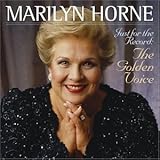
Decca's release of this career-spanning Marilyn Horne recital contains many "golden" nuggets, but isn't the absolute best representation of her artistry, in my opinion.
There was certainly plenty of material to choose from, as Horne was one of the most recorded mezzos in the twentieth century.As advertised, Madame Horne personally approved the final recital list, and the diva undoubtedly has sentimental attachment to certain selections.Furthermore, a conscious attempt was made to represent the different genres explored during her decades-spanning career.This approach, however, leaves out some truly stunning material that would have made an even stronger case on why she was such an operatic institution.
In summary:
The first disc begins with the Habanera from Carmen.Horne was very proud of her Carmen, noting that it surpassed sales of Callas's Tosca at one point.It deserved to be included, but I don't think she was "THE" Carmen, and besides, the whole opera is so warmed-over by now, it's hard to get anyone excited about it!
From then on, we are treated to a bonanza of wonderful arie and scena.The aria from Samson et Delilah is a real gem.Horne was certainly not the most glamorous singer, but My God, the interpretation is heavenly.This is what the aria sounds like in the hands of a world-class contralto.Eccomi in Babilonia follows, and by anyone's measurement, she is the finest Arsace on record.Blessed with an extraordinary range, she is as fulminating in both the top and bottom registers.What's more, her spirited delivery magnifies the pure genius of Rossini's music.As for Cruda Sorte, "ditto," as Marilyn herself might say.
Next, we are treated to two excellent Handel arias.Iris, Hence Away gives me goosebumps everytime I hear it.This was recorded in the early sixties, for inclusion in the Age of Bel Canto recital she shared with Joan Sutherland and Richard Conrad.Now, if she had recorded this a few years later, she might have drove the coloratura harder.However, at this point, the voice had a somewhat lighter quality, thus the aria isn't sung with that all-purpose "Marilyn Horne" voice we are so used to.Speaking of lightness, Dove Sei, Amato Bene will send shivers down your spine.Again, Marilyn wasn't known for her subtlety, but she proves here that she was more than capable.Just listen to the fluttering trills and fil di voce, and dare to disagree with me!One of my major complaints is it there isn't more Handel on the recital.Sure, a whole recital of Handel arias by Horne is still available, but in this best-of disc, there was room at least for Or La Tromba, the trumpet aria from Rinaldo, and a personal favorite.Also, nothing is included from Vivaldi's Orlando Il Furioso, another travesty.
The pinnacle of the first disc is Addio, I Miei Sospiri, from Gluck's Orfeo ed Euridice.This is Horne magified to the nth power.Where to start?A scrumptiously sung recitativo, then the aria itself, with Marilyn pulling out all the stops.The bronzed tone, perfect breath control, spectacular coloratura fireworks, superlative diction, evenness and security from top to bottom, and Marilyn's own way of generating excitement will floor you.This is bravura singing at the highest level.
After a few other selections from the French reperetoire, the disc closes with two Rossini warhorses.Again, the "ultimate" Horne best-of would have saved room for more Rossini, on the second disc.But the evidence here is ample enough to proclaim her honorific as the leading interpreter of Rossini in the last century.
The second disc is less satisfactory.The first selection, Superbo Di Me Stesso sounds like it came from an inferior source, and wasn't remastered properly.Il Segreto Per Esser Felici, from Lucrezia Borgia is fine enough, but Marilyn could have ornamented more, and that snare drum is too loud!Then, we have an extended scene from Il Trovatore.Now, Marilyn herself stated that she wasn't perfect in Verdi.As she put it, she sang Verdi by not taking "both feet" out of the bel canto waters, so that she could go on singing the roles that brought her the most fame.This is understandable, but if that's the case, then we didn't need this long scene.Perhaps she wanted to highlight her collaboration with Luciano Pavarotti, and I'm sure Decca saw this as a way to lure the casual listener.For my money, though, they should have just included Stride La Vampa, and called it a day.This would have freed up lots of room for the stuff for which she's better recognized!
Now, another extended scene, from Norma, is completely justified.Equally important to Marilyn's legacy as an individual artist is her legacy as one-half of the Sutherland/Horne duo.I don't need to write more- the music speaks for itself.
The rest of the second disc throws in a bit of verismo (Horne is unrecognizeable in Ponchielli; Simionato she's not), a bit of German lieder, and some patriotic tunes.Along with Leontyne Price, Marilyn Horne was the most conciously patriotic singer out there, and to have left out her American recordings would have been a disgrace.But, again, we are given an ample serving of it, when it could have been scaled back some to make room for her operatic triumphs.
All in all, there is enough glorious material here for any fan of the legendary Marilyn Horne, and also those who want a taste of how a superlative mezzo/contralto sounds like.
Click Here to see more reviews about:
Just for the Record: The Golden VoiceProduct Description: No Description Available.
Genre: Classical Music
Media Format: Compact Disk
Rating: Release Date: 11-NOV-2003
Buy cheap Just for the Record: The Golden Voice now
![Best of the Mantovani Orchestra [Box set]](http://ecx.images-amazon.com/images/I/21ECH08ABDL._AA160_.jpg) The quality of the recording is poor. You can hear flutter in the string passages, which is 90% of Mantovani's music! There is also hiss noise, and pops in piece transitions... Amateur transcription from tape to CD's, is my guess. Someone else made bad reviews regarding the poor recording on the same record label, so my suggestion is to stay away from the label Madacy Records.
The quality of the recording is poor. You can hear flutter in the string passages, which is 90% of Mantovani's music! There is also hiss noise, and pops in piece transitions... Amateur transcription from tape to CD's, is my guess. Someone else made bad reviews regarding the poor recording on the same record label, so my suggestion is to stay away from the label Madacy Records.